Thriving in Continuous Change: A Summary From Our Recent Webinar
Change is no longer something organisations move through and then come out the other side of. For many leaders, project teams and change practitioners, it is now a constant part of the operating environment.
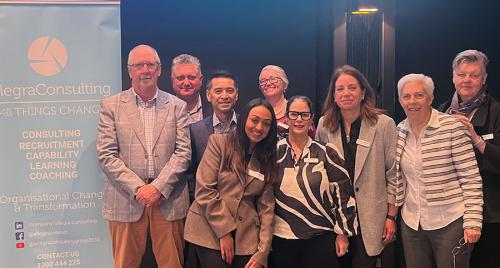
That was the focus of our recent free live webinar, Thriving in Continuous Change - 2026 Transformation Strategies, where Caroline Mills, Tracey Penington, Seath Fraser and Tim Robinson from the Allegra Consulting leadership team explored what organisations need to consider as they navigate more complex, overlapping and continuous change.
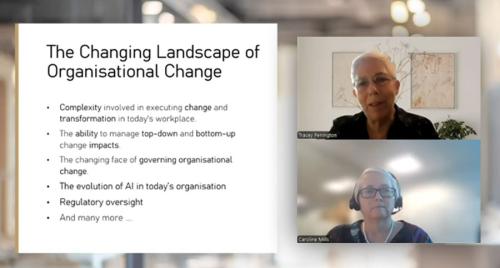
Following the webinar, Caro and Tracey shared a short video summary (above) of some of the key themes discussed. These included the changing nature of organisational transformation, the growing role of AI, the increasing importance of psychosocial risk, and the capabilities change practitioners may need to strengthen in the years ahead.
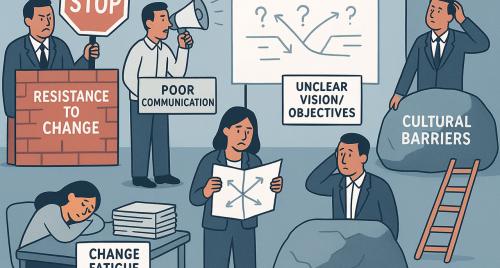
Change Is Becoming More Continuous And More Complex
One of the strongest themes from the discussion was that change is no longer happening in neat, contained phases.
"Change is accelerating. It is speeding up. It is a lot more complex than it used to be and it is continuous."
Organisations are not just managing one change at a time. In many environments, multiple changes are happening simultaneously, often with large-scale transformation layered over the top. This creates a more complex landscape for leaders, teams and change practitioners to work through.
It also means that organisations need to think differently about how change is governed, prioritised and supported. The old question of "when will this change stop?" is becoming less useful. A better question may be: "how do we build the capability, systems and leadership practices needed to work well in continuous change?".
Transformation, AI And The Changing Risk Landscape
The webinar also explored the impact of larger transformation agendas, including digital transformation and AI.
AI continues to sit high on the agenda for many organisations. As discussed in the session, it presents both opportunity and risk. For change practitioners, the challenge is not simply to understand the technology, but to understand how it affects people, work, decision-making, capability and trust.
At the same time, the broader risk environment is shifting. Caro highlighted the growing importance of psychosocial hazards legislation across Australia, including the way organisational change itself can contribute to psychosocial risk if not managed well.
"Smack bang in the centre of that list of psychosocial hazards is organisational change."
This is an important reminder for leaders and change practitioners. Change is not just a delivery activity. It has a direct impact on people’s workload, role clarity, psychological safety, wellbeing and ability to perform.
What This Means For Change Practitioners
The session also looked at the capabilities change practitioners may need as the profession continues to evolve.
Caro described several capability areas that are becoming increasingly important, including:
- human-centred and behavioural capability
- strategic and commercial thinking
- systems thinking and the ability to see change holistically
- digital, data and AI literacy
- leadership influence, coaching and facilitation
- learning agility and future readiness
A key message from the discussion was that change practitioners are not there to "own" the change on behalf of the organisation. Rather, they help facilitate change with and through leaders, business units, project teams and employees.
That makes influence, coaching and facilitation increasingly important. Change practitioners need to be able to work across different levels of an organisation, connect the dots between strategy and delivery, and support leaders to play their role effectively.
Building Future-Ready Change Capability
Continuous change requires more than a fixed toolkit. It requires curiosity, adaptability and the ability to draw on multiple approaches depending on the context.
As organisations move into 2026, the ability to respond well to complexity will be critical. That includes understanding human behaviour, working with data and AI, assessing risk more broadly, and helping organisations make clearer decisions about what change matters most.
Our recent webinar was a valuable opportunity to explore these themes with leaders and practitioners who are navigating these realities every day.
Join Us For Future Free Events
This webinar was part of our ongoing series of free 1 hour virtual events designed to support leaders, change practitioners and organisations as they respond to evolving workplace challenges.
If you are interested in organisational change, transformation, leadership capability, psychological safety, AI, or future-ready ways of working, we invite you to register for our upcoming events and training here.
About the authors

Caroline Mills
Caroline has led Allegra Consulting for more than 15 years, transforming the business into one of Australia's… View profile

Seath Fraser
Seath is a highly regarded specialist in Change and Transformation recruitment, with more than 15 years'… View profile

Tim Robinson
Tim is a proven change professional with an extensive and diverse career in public and private sectors across Australia… View profile

Tracey Penington
Tracey is a Transformation Specialist, Futurist and Entrepreneur but has spent most of her career developing solutions… View profile
Related services & courses

ACADEMY COURSES
Change Professional 3-Day Course
This 3-day course is designed for Executives, Leaders and those looking to advance and enhance their careers by being able t…

ACADEMY COURSES
Transformation Practitioner 3-Day Course
This course is designed for Change Professionals, Consultants, Executives and those looking to advance and enhance their car…

ACADEMY COURSES
Introduction to AI for Change Professionals 1/2-Day Workshop
This half-day workshop is for change professionals looking to learn more about using AI tools in their change initiatives an…