The Moment Before You Speak
There’s a moment most of us recognise at work, even if we don’t talk about it. You’re in a meeting, someone senior asks a question, and you have a different view - but you hesitate. You weigh it up. Is it worth saying? Will it land well? Will it make things awkward? And so, more often than not, you stay quiet.
Now imagine that moment multiplied across a team, a business, an entire organisation - particularly during a period of change.
Because when things are shifting - new systems, new structures, new expectations - that hesitation tends to grow. And that’s where psychological safety becomes not just important, but critical.
Psychological Safety: The Foundation for Navigating Change
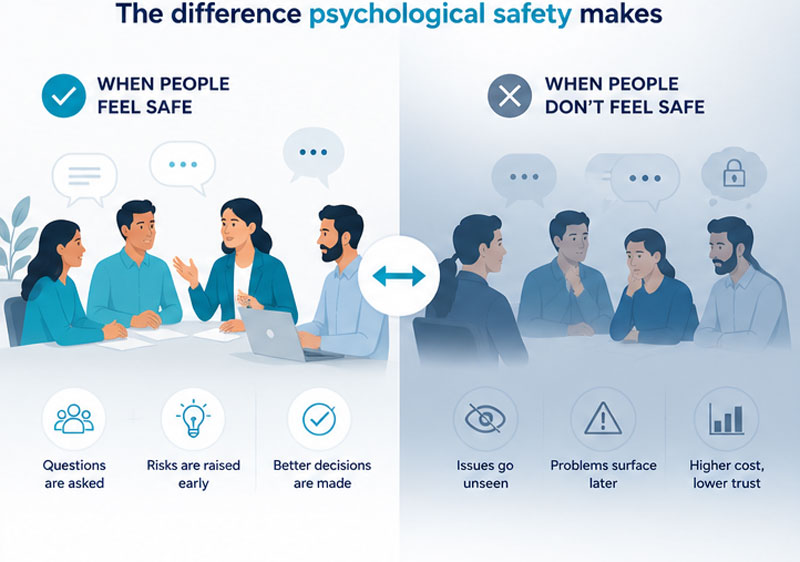
At its core, workplace psychological safety is about whether people feel safe enough to speak up - safe to ask questions, challenge ideas, admit mistakes, and contribute without fear of embarrassment or negative consequences.
In stable environments, that matters. In changing environments, it becomes essential.
Change relies on people raising risks early, asking for clarity, flagging what isn’t working, and offering ideas for improvement. Without psychological safety, those signals don’t disappear - they just go underground. Leaders are left making decisions with partial information, and issues surface later, often at a higher cost.
A useful way to think about it is to think of it like oxygen. You don’t really notice it when it’s there, but when it’s missing, everything becomes harder. Decision-making slows, resistance increases (even if it’s unspoken), and people shift from contributing to protecting themselves.
Psychosocial Hazards: What Gets in the Way
If psychological safety is what enables people to engage with change, psychosocial hazards are often what quietly undermine it.
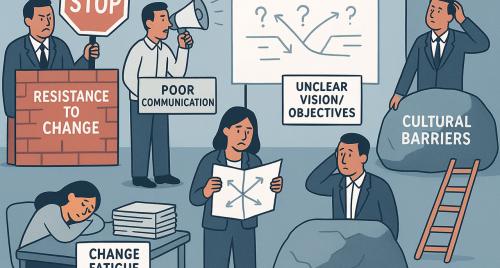
These are aspects of work design, leadership, and the work environment that can cause psychological harm. They’re not always dramatic or obvious. More often, they show up in the everyday - unclear expectations, competing priorities, excessive workloads, poor communication, inconsistent leadership, or a lack of genuine consultation.
During change, these hazards tend to intensify.
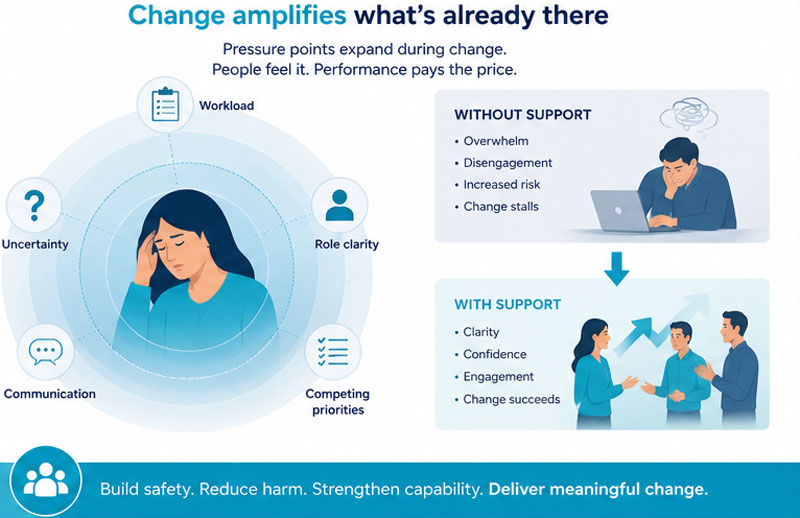
Think of them like pressure points in a system. When demand increases - as it often does in transformation - those pressure points expand. Role ambiguity becomes confusion. Tight deadlines become chronic overload. Limited communication becomes speculation and rumour. And before long, people stop raising concerns because experience tells them it won’t lead to anything constructive.
Change Amplifies What Already Exists
One of the more important realities in change management is that transformation doesn’t create culture - it reveals and amplifies it.
If there’s a baseline of trust and psychological safety, change can feel challenging but navigable. People are more likely to lean in, test ideas, and work through ambiguity together.
If that foundation isn’t there, change tends to expose the cracks. Hesitation turns into silence. Silence turns into disengagement. And disengagement often gets misread as resistance, when in reality it’s a signal that the environment doesn’t feel safe enough to participate.
This is where psychosocial hazards and psychological safety intersect in a very practical way. The presence of one, and the absence of the other, will directly shape how change is experienced on the ground.
From Compliance to Capability
There’s also been a broader shift in how organisations are expected to approach these issues. Psychosocial hazards are now firmly on regulators' radar, with a clear expectation that they are identified, assessed, and managed like any other workplace risk.
But in a change context, this is more than a compliance exercise. It’s about capability.
Organisations that actively manage psychosocial risk - by designing work more thoughtfully, supporting leaders to lead well through change, and creating environments where people can speak up - are better positioned to adapt. They get earlier visibility of issues, more meaningful input from their people, and stronger alignment as things evolve.
A Practical Lens for Change
Use for the opening practical questions:
So rather than asking “Do we have psychological safety?” it can be more useful, particularly in the context of change, to take a more practical lens.
For example:
- In our change initiatives, are we making it easier or harder for people to speak up?
- Where might uncertainty be sitting, and how are we addressing it?
- What in our systems, structures, or timelines might be creating unnecessary pressure or confusion?
- Are we actively inviting input, or unintentionally signalling that decisions are already made?
Making Psychosocial Risk Part of the Change Risk Profile
Importantly, psychosocial hazards don’t sit outside of change; they often sit within it. Which means they should be considered as part of your broader change risk profile, not as a separate or parallel conversation.
Just as you would identify operational or delivery risks, there’s value in asking: what are the human risks in this change? Where might workload increase beyond sustainable levels? Where might role clarity drop? Where could people feel a loss of control, status, or certainty?
This is where frameworks like SCARF can provide a useful lens. By considering Status, Certainty, Autonomy, Relatedness, and Fairness, leaders can more deliberately scan for potential psychosocial impacts - particularly those that might not be immediately visible but are felt strongly by individuals and teams.
Building ChangeFitness® Without Burning People Out
Equally, this isn’t something change teams need to solve in isolation. Partnering closely with People & Culture functions can provide deeper insight into organisational dynamics, existing risk areas, and practical actions to mitigate harm while still advancing change.
Over time, organisations that do this well tend to move beyond reacting to issues as they arise. They start to build capability - developing stronger change leadership at all levels and supporting individuals in navigating change more effectively. We often talk about this as building ChangeFitness® - the organisational capacity to absorb, adapt, and respond to change without it coming at the expense of wellbeing or performance.
Because ultimately, successful change isn’t just about delivering the outcome. It’s about how people experience the journey getting there - and whether that experience enables them to stay engaged, contribute meaningfully, and sustain performance over time.
If this is something you’re navigating, it’s a space we spend a lot of time in - working with organisations to integrate psychosocial risk thinking into change, strengthen leadership capability, and build practical, sustainable approaches to resilience in change, so reach out to us.
About the authors

Caroline Mills
Caroline has led Allegra Consulting for more than 15 years, transforming the business into one of Australia's… View profile
Related services & courses

CONSULTING SERVICES
Workplace psychological safety
Personalised services for organisations seeking to foster a psychologically safe workplace where their people thrive, innova…