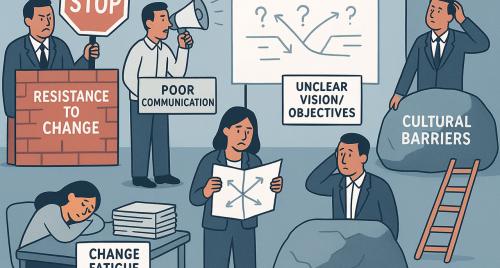
As I approach the end of my working life, after almost 50 years in the workforce, this feels like an appropriate time to reflect on my journey with change, and why, relatively late in my career, I came to embrace Change Management as a discipline.
Much has changed during that time.
I began my career in banking when handwritten ledgers and weekly return submissions were part of everyday working life. I have since witnessed the introduction of computers, increasingly sophisticated enterprise systems, cloud technology and, most recently, artificial intelligence.
Along the way, I have been directly and indirectly involved in numerous workplace changes. I have experienced change across the full spectrum - from initiatives that were managed poorly and created unnecessary disruption, to those that were managed exceptionally well and delivered lasting benefits.
Change has changed
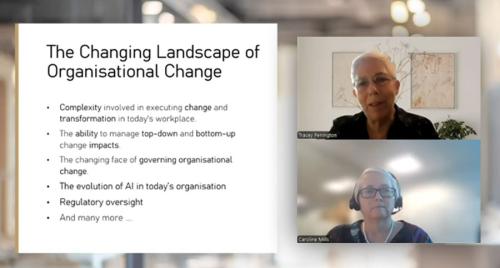
The scale and nature of workplace change have evolved significantly.
New technologies, mergers and acquisitions, organisational restructures and even global pandemics have progressively changed not only what organisations need to change, but also how they need to approach change.
The speed of change has accelerated dramatically as well.
What has been equally significant, however, is the evolution in our understanding of the human side of change. Today, organisations are much more likely to consider how a transformation affects roles, behaviours, ways of working and individual employees - not simply whether a new process or technology can be implemented.
That represents an important shift.
My first real lesson in change
My first significant personal experience of leading change occurred in 1986, when I centralised document management that had previously been managed in-house across distributed sites.
At the time, terms and concepts such as Ways of Working, Target Operating Models and even Change Management did not exist as recognisable disciplines in the way they do today.
The initiative involved breaking apart a process that had evolved over many years. It was also enabled by the first introduction of desktop computers, although these were available only at selected locations and certainly were not accessible to everyone.
Our approach to change at the time could probably be summarised as:
Make the decision, implement it, work out the issues afterwards and expect people to comply.
It is a very different proposition from how we would approach significant organisational change today.
I managed to muddle my way through to a successful outcome, although I suspect strong relationships with stakeholders played a much greater role in that success than any formal methodology. I should probably also acknowledge that my personal motivation to achieve a promotion helped!
Looking back, however, there was an important lesson hidden in that experience.
Relationships mattered.
Even without a formal Change Management framework, engaging with people, building trust and maintaining strong stakeholder relationships helped make the change possible.
That lesson has remained relevant throughout my career.
From managing implementation to managing impact
Today, we recognise that successful change requires much more than making the right strategic or technical decision.
Organisations increasingly consider how a change will affect existing ways of working, business processes, organisational structures and, importantly, individual employees.
The behavioural and psychological aspects of change have also become much better understood.
This matters because a technically successful implementation does not automatically translate into a successful organisational outcome. A new system can be installed, a new operating model can be launched, and a new organisational structure can appear on paper. But the intended benefits will only be realised when people understand the change, are prepared for it and can work effectively in the new environment.
For leaders, that means asking questions such as:
- Who will be affected, and how will their day-to-day work change?
- Have the people closest to the work been involved early enough?
- Do employees understand why the change is necessary and what it means for them?
- Are leaders visibly supporting the change through their actions as well as their words?
- What needs to happen after implementation to ensure new behaviours and ways of working are sustained?
These questions may seem obvious today. They were far less prominent when I began my career.
That alone shows how far the discipline has come.
One lesson has remained constant
My own journey with change has been long and, at times, tortuous.
I have experienced change from almost every perspective: as a decision-maker, a leader, an impacted employee and, eventually, as a Change Management practitioner.
Across all of those experiences, one theme has remained remarkably consistent:
Strong stakeholder engagement matters.
Processes, methodologies and technologies will continue to evolve. The terminology we use will undoubtedly change as well.
But people still need to understand what is happening. They need opportunities to contribute. They need leaders they trust. And they need to see how the change connects to the work they do.
Effective stakeholder engagement is therefore not simply a communications activity or a task within a change plan. At its best, it creates understanding, identifies issues earlier, builds ownership and gives organisations a much stronger foundation for achieving sustainable change.
Where Change Management goes next
The voice of Change Management is now heard much more clearly and strongly within organisations than it was earlier in my career.
That is positive progress.
But I still believe there is further to go.
Change considerations do not always fully permeate the thinking of those making strategic decisions. Too often, the question of how people will experience and adopt a change is considered after the major decisions have already been made.
The opportunity for organisations is to bring Change Management thinking into the conversation earlier.
When leaders consider the people implications alongside strategy, technology, finance and operations - not after them - they are more likely to identify risks earlier, make better-informed decisions and create the conditions for successful adoption.
After almost five decades of workplace change, perhaps that is my biggest reflection.
Change Management has evolved enormously, but the fundamental principle remains surprisingly simple: successful change happens through people, not to people.
And organisations that remember that are far more likely to turn change from something employees have to endure into something they can understand, contribute to and ultimately help make successful.
About the authors

Tim Robinson
Tim is a proven change professional with an extensive and diverse career in public and private sectors across Australia… View profile